
CES 2026: The Intelligent Transformation

Physical AI, Domestic Manufacturing, and the New Computing Paradigm#
If there's a single takeaway from CES 2026, it's this: artificial intelligence has graduated from software feature to physical infrastructure. The show that ran January 6-9 in Las Vegas wasn't really about gadgets anymore—it was about the machinery that will power the next decade of computing.
Over 4,100 exhibitors showed up, including 1,200 startups, and somewhere between 145,000 and 148,000 professionals walked the floor (the count depends on who's doing the counting and whether media days are included).12 The official theme was "AI Everywhere," which sounds like marketing copy until you see what it actually meant: robots that can reason about physics, chips manufactured on American soil for the first time in a generation, and autonomous vehicles priced for the middle class rather than the wealthy.
The announcements that mattered most weren't the flashiest ones. NVIDIA's Vera Rubin platform will define how AI gets built for years. Intel's 18A process—backed by an unprecedented federal investment—marks a genuine shift in where advanced semiconductors come from. Ford promised Level 3 autonomy in a $30,000 truck. These are infrastructure plays, not consumer products, and they're exactly why the show felt different this year.345
And then there were the robots. Boston Dynamics showed genuine progress. Several others fell on their faces—in one case, literally onto a journalist. That gap between ambition and execution turned out to be one of the more honest things CES 2026 revealed about where we actually stand.6
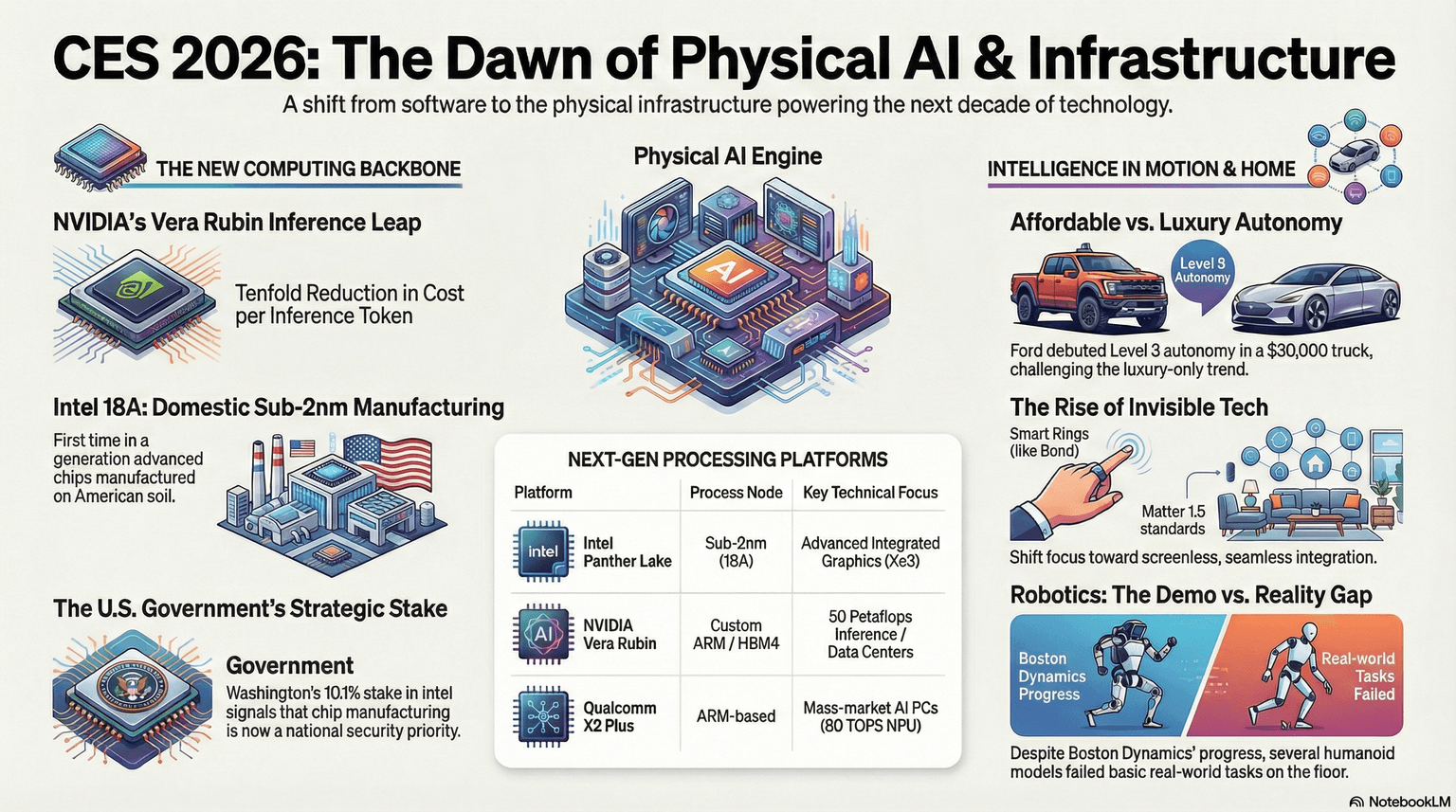 The dawn of physical AI & Infrastructure
Event Overview#
The numbers tell part of the story. A record 3,600 products entered the Innovation Awards competition, more than 55% of attendees held senior executive titles, and the keynote lineup read like a who's who of tech leadership: Jensen Huang from NVIDIA, Lisa Su from AMD, Lip-Bu Tan (newly installed at Intel), Cristiano Amon from Qualcomm, and Best Buy CEO Corie Barry.78
| Attribute | Detail |
|---|---|
| Official Dates | January 6-9, 2026 (Media Days: January 4-5) |
| Primary Theme | AI Everywhere / Intelligent Transformation |
| Total Exhibitors | 4,100+ (including 1,200 startups) |
| Professional Attendance | 145,000-148,000 |
| Innovation Award Entries | 3,600 (record-breaking) |
| Senior Executive Participation | >55% of total attendees |
| Major Keynote Speakers | Jensen Huang (NVIDIA), Lisa Su (AMD), Lip-Bu Tan (Intel), Cristiano Amon (Qualcomm), Corie Barry (Best Buy) |
But the structure of the show revealed something more interesting. CTA added a full manufacturing track this year, along with expanded sessions on retail technology and industrial applications. There were booths dedicated to small modular nuclear reactors and fusion energy. The "full enterprise stack" was on display—not just the consumer electronics that gave CES its name, but the entire technological infrastructure that makes those products possible.19
NVIDIA and the Physical AI Era#
Jensen Huang's keynote had the longest lines of the entire show—queues that wrapped around two floors. That's not surprising given what he announced.3
The Vera Rubin platform is NVIDIA's bid to define AI infrastructure for the next several years. It's a six-chip system built around the Vera CPU (88 custom ARM cores, 128GB of GDDR7 memory) paired with the Rubin GPU, which delivers 50 petaflops of inference performance and 288GB of HBM4 memory running at 22 terabytes per second.310 Those numbers are impressive on their own, but the real pitch is economic: NVIDIA claims a tenfold reduction in the cost per inference token compared to current Blackwell systems. AWS, Google Cloud, and Microsoft Azure have all committed to deployments in the second half of 2026.311
Vera Rubin platform
NVIDIA Kicks Off the Next Generation of AI With Rubin — Six New Chips, One Incredible AI Supercomputer
NVIDIA today kickstarted the next generation of AI with the launch of the NVIDIA Rubin platform, comprising six new chips designed to deliver one incredible AI supercomputer.
nvidianews.nvidia.com/news/rubin-platform-ai-supercomputerThe company framed this around what they're calling the "Three-Computer Solution." DGX handles model training. Omniverse and the new Cosmos platform handle simulation and validation. DRIVE handles real-time execution in vehicles. The Cosmos piece is particularly interesting—it provides "world foundation models" that let robots reason about physics and causality, generating synthetic training data at scale rather than relying on expensive real-world capture.12
Key NVIDIA Announcements#
| Model/Framework | Technical Capacity | Core Function |
|---|---|---|
| Alpamayo 1 (VLA) | 10B Parameters | Reasoning-based decision making for mobility; verbalizes decision logic |
| AlpaSim | Open-source framework | High-fidelity closed-loop sensor simulation |
| Vera Rubin NVL72 | 50 petaflops inference | Full-stack AI supercomputer for data centers |
| DGX Spark | Desktop supercomputer | Local training for models up to 200B parameters |
| DLSS 4.5 | 6X mode available | Dynamic multi-frame generation; 250+ games supported |
NVIDIA Alpamayo
NVIDIA also released Alpamayo, an open-source toolkit for autonomous vehicle development. The centerpiece is a 10-billion-parameter Vision-Language-Action model that can verbalize its reasoning—explaining why it's making specific driving decisions, which matters enormously for safety certification and regulatory approval. Mercedes-Benz, Jaguar Land Rover, Lucid, and Uber have already signed on as early adopters, and NVIDIA released over 1,700 hours of global driving data to support the ecosystem.1213
NVIDIA Announces Alpamayo Family of Open-Source AI Models and Tools to Accelerate Safe, Reasoning-Based Autonomous Vehicle Development
NVIDIA today unveiled the NVIDIA Alpamayo family of open AI models, simulation tools and datasets designed to accelerate the next era of safe, reasoning‑based autonomous vehicle (AV) development.
nvidianews.nvidia.com/news/alpamayo-autonomous-vehicle-de...AMD, for its part, announced the Helios Rack System (72 MI455X GPUs) and claimed a 1,000x performance improvement with the Instinct MI500 series over MI300X. On the gaming side, the Ryzen 7 9850X3D got a 400MHz clock bump and the "fastest gaming processor" designation.14
AMD “Helios’’: Advancing Openness in AI Infrastructure Built on Meta’s 2025 OCP Open Rack for AI Design
AMD “Helios” built on Meta’s OCP Open Rack for AI redefines open, scalable infrastructure for next-generation AI and HPC innovation.
amd.com/en/blogs/2025/amd-helios-ai-rack-built-on-metas-2...When asked about AI bubble concerns, Huang dismissed them by pointing to what he called the "AI factory era"—arguing that investment in actual silicon and data center infrastructure provides a fundamentally different foundation than previous tech hype cycles.15
Intel, Geopolitics, and Domestic Manufacturing#
The Intel story at CES 2026 is inseparable from the federal government's decision, back in August 2025, to take a 10.1% stake in the company.4
That $11.1 billion dollars investment (including $8.9 billion for primary shares) made the U.S. government one of Intel's largest shareholders. It also came with a "golden share"—a non-equity position that gives Washington control over certain decisions deemed vital to national interests. The government doesn't have a board seat and its ownership is officially passive, but the message was clear: semiconductor manufacturing is now a matter of national security.1617
Intel had been stuck in a catch-22. They needed customer confidence to land orders, but they needed orders to fund the production capacity that would earn that confidence. The federal investment broke that cycle. Four months later, Intel's stock had surged 75%, nearly doubling the taxpayers' stake to over $18 billion.18
Which brings us to Panther Lake. The Core Ultra Series 3 processors represent the first chips built on Intel's 18A process—sub-2-nanometer technology, and the most advanced semiconductor manufacturing happening in the United States. The RibbonFET transistor architecture delivers 15% better performance per watt, and the integrated Arc B390 graphics outperform Lunar Lake's integrated GPU by 77% in gaming workloads.419
https://newsroom.intel.com/client-computing/introducing-panther-lake-by-the-numbersProcessor Platform Comparison#
| Feature | Intel Panther Lake | AMD Ryzen AI 400 | Qualcomm X2 Plus |
|---|---|---|---|
| Process Node | Sub-2nm (18A) | Zen 5 Architecture | ARM-based Snapdragon |
| NPU Compute | Advanced AI Engine | 60 TOPS | 80 TOPS |
| Key Focus | Integrated Xe3 Graphics | Enterprise Efficiency | Mass-market AI PCs |
| Target Device | Premium AI Laptops | Prosumer Workstations | $800+ consumer laptops |
Pre-orders opened January 6, with global availability on January 27. Over 200 PC designs from various partners will ship throughout 2026.4
Qualcomm pushed back with the Snapdragon X2 Elite, claiming 44% more CPU performance per watt than Intel's Core Ultra 9 285H and an 80 TOPS NPU for Copilot+ PCs. They also announced Dragonwing IQ10, a chip specifically designed for robotics, with Figure and VinMotion signed on for humanoid robot development.1920
Computing and Laptop Innovation#
The laptop category had more genuine surprises than it has in years.
ASUS showed the ROG Zephyrus Duo—the first 16-inch dual-screen OLED gaming laptop. Both Nebula OLED panels hit 1,100 nits in HDR, and the top configuration pairs Intel Core Ultra with an RTX 5090. It's excessive in the best possible way.21
ROG Zephyrus Duo (2026) GX651 | ROG Zephyrus | Gaming Laptops|ROG - Republic of Gamers|ROG Global
2026 ROG Zephyrus Duo is the world's first dual 16" screen gaming laptop, with Intel Processor and up to NVIDIA GeForce RTX 5090, dual 3K OLED displays.
rog.asus.com/laptops/rog-zephyrus/rog-zephyrus-duo-2026/Lenovo's conceptual entry was the Legion Pro Rollable, a flexible OLED that expands from 16 inches to 21.5 inches (and even 23.8 inches in one mode), shifting from a 16:10 aspect ratio to an ultrawide 24:9. Lenovo held their keynote at The Sphere and brought executives from NVIDIA, Microsoft, Intel, Qualcomm, and AMD onstage, plus Gwen Stefani for some reason.22
Lenovo Levels Up CES with Legion Pro Rollable Concept and Latest Gaming Devices - Lenovo StoryHub
Lenovo™ announced the newest additions to its portfolio of gaming devices designed to help esports athletes, student gamers, and mobile gamers.
news.lenovo.com/pressroom/press-releases/lenovo-levels-up...The most interesting Dell announcement wasn't a new product—it was an admission that their 2025 rebranding had been a mistake. The XPS name is back for the 13, 14, and 16-inch models.23 Their UltraSharp 52 Thunderbolt Monitor, meanwhile, targets serious multitaskers: 52 inches, 6K resolution, 120Hz refresh, IPS Black panels.24
Samsung's Galaxy Book6 Ultra shipped with Intel Core Ultra X9, NVIDIA RTX 5070/5060 options, and haptic trackpads—a first for Samsung laptops.25 HP's OmniBook Ultra 14 manages vapor chamber cooling in a chassis just 0.42 inches thick, starting at $1,550.26
Display Technology: The Brightness Wars#
TV manufacturers have settled on their next battleground: RGB-based backlighting systems that push color gamut toward 100% BT.2020 coverage, the theoretical limit of human color perception.27
The jargon this year was "Micro RGB"—precise LED arrangements that produce more accurate color than conventional backlighting. Every major manufacturer had something to show.
Major Display Announcements#
| Brand | Model | Technology | Key Specifications |
|---|---|---|---|
| Samsung | R95H Series | Micro RGB | 55-115", Glare Free finish, Eclipsa Audio |
| Samsung | QD-OLED 2026 | QD-OLED | 4,500 nits peak (35% over S95F) |
| Samsung | Transparent Micro LED | Micro LED | Best of Show winner; seamless glass-like transparency |
| LG | OLED evo W6 | Wallpaper OLED | 9mm thick, 100", Zero Connect wireless to 30 ft |
| LG | G6 Flagship | Primary RGB Tandem 2.0 | ~3,000 nits peak; 3.9x conventional OLED brightness |
| TCL | X11L | Mini LED | 10,000 nits peak; 20,000+ dimming zones |
| Hisense | 116UXS | Micro RGB (RGBC) | 110% BT.2020 via cyan fourth pixel |
| Hisense | 163MX MicroLED | MicroLED (RGBY) | Best of Innovation Award; est. $100,000+ |
Samsung's R95H series brings Micro RGB to sizes from 55 to 115 inches, with a Glare Free anti-reflection finish and Eclipsa Audio (a spatial sound format developed with Google). Their QD-OLED panels now hit 4,500 nits peak brightness—35% brighter than last year's S95F flagship.27
Samsung Unveils World’s First 130-Inch Class Micro RGB TV Featuring Next-Generation Color and Bold New Design
Debuting with advanced picture performance, the new 130-inch class Micro RGB TV sets a new standard for ultra-premium displays
news.samsung.com/us/samsung-unveils-worlds-first-130-inch...LG brought back the Wallpaper TV after a hiatus. The OLED evo W6 is just 9mm thick at 100 inches, with Zero Connect handling wireless 4K video from up to 30 feet away. The G6 flagship uses Primary RGB Tandem 2.0 panels to reach roughly 3,000 nits—3.9 times the brightness of conventional OLEDs.27
TCL went for sheer output with the X11L: 10,000 nits peak brightness and over 20,000 local dimming zones. That's among the brightest consumer displays ever shown.28
Hisense took a different approach, adding a fourth cyan pixel to their 116UXS to hit 110% BT.2020 coverage. Their 163MX MicroLED won the Best of Innovation Award, though pricing will likely exceed $100,000.2930
Samsung Display also demonstrated Mont Flex, a crease-free flexible OLED using laser-perforated metal—potentially destined for a future foldable iPhone.31
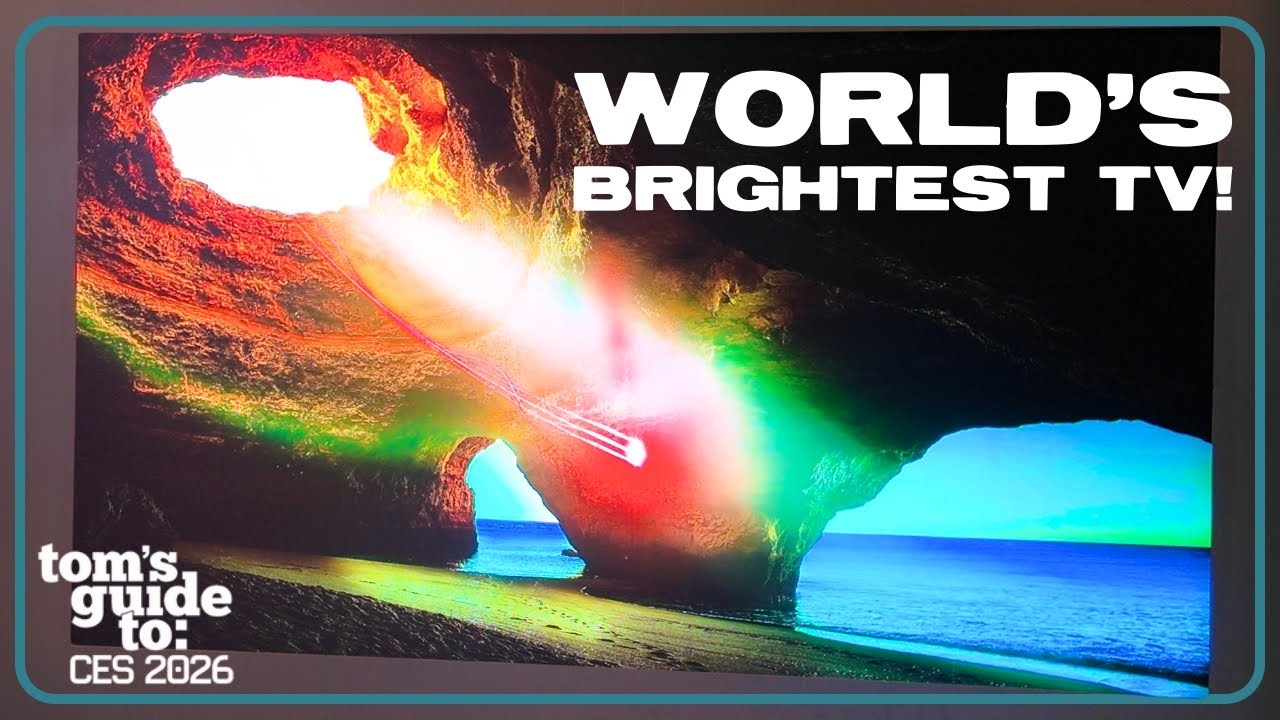
What wasn't on the floor was almost as notable: no 8K push, no Sony TV announcements, no Panasonic. The industry seems to have collectively decided that brightness and color accuracy matter more than resolution right now.
Autonomous Vehicles and Mobility#
The automotive side of CES pivoted hard from electric vehicle announcements toward autonomy. The framing from several companies was that vehicles should be "creative entertainment spaces"—valued for software-defined experiences rather than mechanical performance.32
Ford Bets on Affordable Autonomy#
Ford's announcement cut against the industry's luxury-first approach to self-driving. They committed to eyes-off Level 3 driving by 2028, debuting on a $30,000 midsize electric pickup built on a new Universal Electric Vehicle platform. CEO Doug Field put it bluntly: "Autonomy shouldn't be a premium feature."5
The system costs 30% less to build than current BlueCruise technology. That's a meaningful bet—Ford is wagering that autonomous driving becomes a mass-market expectation rather than a high-end differentiator.
Ford’s Next EV Pickup to Get Level 3 ‘Hands-Free, Eyes-Off’ Tech by 2028 | EV.com
The truck, built on Ford’s upcoming Universal Electric Vehicle platform, is set to debut in 2027, with full L3 functionality expected to be road-ready in 2028.
ev.com/news/fords-next-ev-pickup-to-get-level-3-hands-fre...Robotaxis Move Toward Reality#
Lucid, Nuro, and Uber jointly unveiled a production-intent robotaxi based on the Lucid Gravity SUV. It seats six, offers Level 4 capabilities, and has 450 miles of range. Commercial service in San Francisco is targeted for late 2026, with Uber planning to deploy 20,000 of these vehicles over six years.33
Waymo announced they're in discussions to raise over $15 billion at a potential $110 billion valuation, with expansion planned to 12 or more markets in 2026. Their 6th-generation Waymo Driver simplifies hardware significantly: 13 cameras (down from 29) and 4 lidar units (down from 5), while maintaining 360-degree perception out to 500 meters.34
Mobility Innovation Overview#
| Vehicle Type | Model | Pricing/Status | Key Innovation |
|---|---|---|---|
| Electric Sedan | AFEELA 1 (SHM) | $89,900-$102,900 | PS5 Remote Play / VLM AI Agent |
| Electric Crossover | AFEELA Prototype 2026 | 2028 market launch | Co-Creation developer API |
| Personal Robocar | Tensor L4 | Production late 2026 | 8,000+ TOPS; retractable controls |
| Ultralight eVTOL | RICTOR X4 | $39,900 | No pilot's license required |
| Flying Car System | Xpeng Land Aircraft Carrier | ~$280,000 | 6x6 mothership + detachable eVTOL |
| Robotaxi | Uber/Lucid/Nuro | SF testing late 2026 | 450-mi range; 6 passengers |
Sony Honda Mobility showed the AFEELA 1 sedan, priced between $89,900 and $102,900 with California deliveries expected late 2026. The pitch is that it's the first "Sony-infused" vehicle—panoramic dashboard displays, PlayStation Remote Play built in, a 45-sensor suite on the Snapdragon Digital Chassis, and an AI personal agent that supposedly learns your preferences. They also announced a "Co-Creation Program" that opens the vehicle's Android-based API to outside developers.32
AFEELA - EV | Sony Honda Mobility
AFEELA: A new generation of mobility pulsing with intelligence. Inviting you to be part of the future of mobility. Reserve yours now.
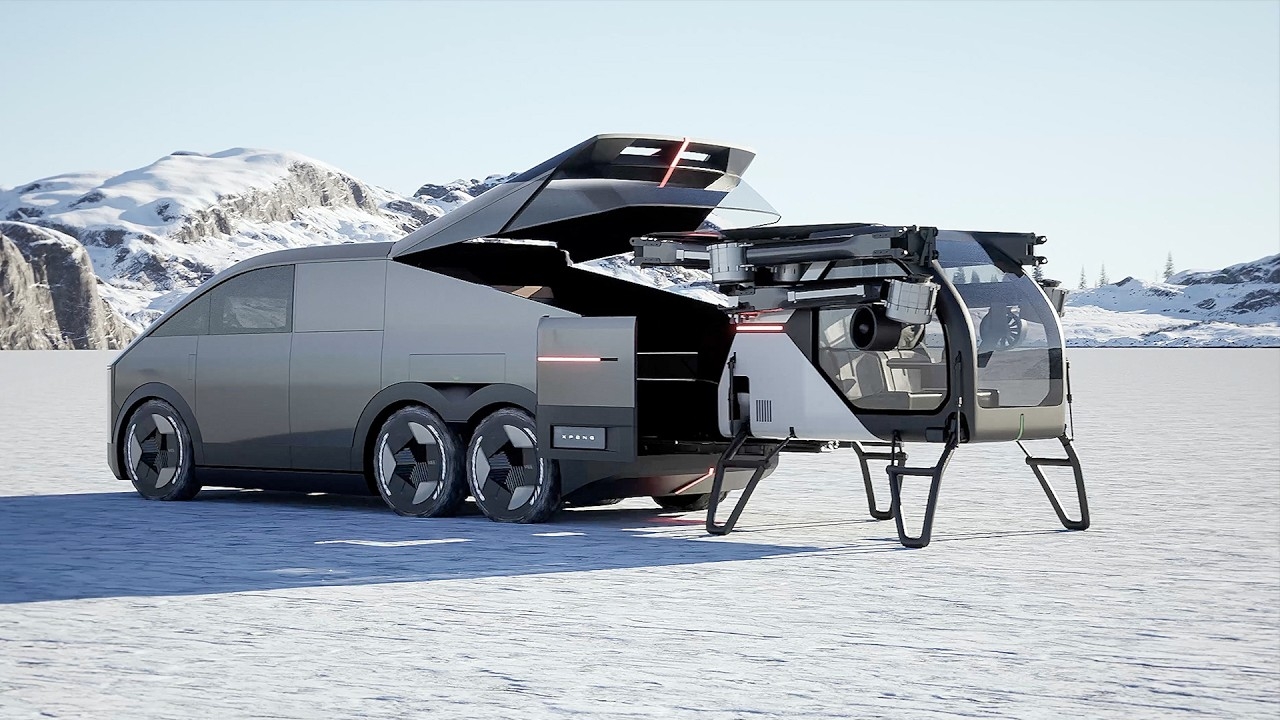
shm-afeela.com/en/The crowd-pleaser was Xpeng's "Land Aircraft Carrier"—a 6x6 ground vehicle that carries a detachable two-seat eVTOL, priced around $280,000. They claim factory capacity for 10,000 units annually and say they already have thousands of pre-orders. It's ambitious, possibly impractical, and unmistakably a statement about where Chinese manufacturers think personal mobility is headed.35
And you have to see this short video:
Silicon Valley startup Tensor debuted what they're calling a "personal robocar"—a Level 4 autonomous vehicle designed for private ownership rather than fleet use. It runs on an NVIDIA-based supercomputer delivering over 8,000 TOPS, with a foldable steering wheel and retractable pedals that turn the cabin into a lounge when you're not driving manually.36
And for $39,900, you can buy the RICTOR X4—an ultralight eVTOL that complies with FAA Part 103 regulations, meaning no pilot's license required. Personal flight is becoming a consumer product category.36
Robotics: Promise and Reality#
The robotics story at CES 2026 is really two stories, and you can't tell one without the other.
The Progress#
Boston Dynamics won CNET's Best Robot award. Hyundai confirmed that Atlas will enter production deployment at their Georgia plant by 2028, with plans for a factory producing 30,000 units annually. A new partnership with Google DeepMind will accelerate AI development.37
I Got Up Close and Personal With Boston Dynamics' New Atlas Robot - CNET
Before Atlas takes its first steps into the world of work later this year, I found myself face-to-face with CES 2026's most talked-about robot on the show floor.
cnet.com/tech/computing/i-got-up-close-and-personal-with-...In industrial settings, the AEON Hexagon stood out—a collaborative robot designed to work alongside humans on repetitive or hazardous tasks. The design deliberately incorporates psychological research on how workers perceive and accept robotic coworkers.38 Doosan's Scan&Go uses physics-informed AI and 3D vision to generate tool paths from point-cloud data without CAD files or code, offering something close to plug-and-play automation for manufacturing.38
Hexagon Taps NVIDIA Robotics and AI Software to Build and Deploy AEON, a New Humanoid
The humanoid robot can help build digital twins for manufacturing and other industries.
blogs.nvidia.com/blog/hexagon-robotics-ai-software-aeon-h...Home robotics crossed what some called a "final threshold" with the Roborock Saros Rover, which has bendable legs that let it climb and clean stairs independently. That's a genuine capability breakthrough—stairs have been a hard boundary for robotic vacuums.19 LG's AI Home Robot connects to their ThinQ platform for tasks like folding laundry, organizing refrigerators, and loading dishwashers.39
The Failures#
But the humanoid robots also provided the show's most memorable disasters, and they're worth dwelling on because they reveal where the technology actually stands.6
LG's CLOiD struggled visibly to fold towels, leaving clothes crumpled and taking over a minute per towel. Switchbot's Onero H1—which is otherwise well-reviewed and priced under $10,000—failed to close a washing machine door after loading clothes incorrectly. And Zeroth's Jupiter robot simply fell forward onto a journalist.6
One publication's headline captured it well: "Humanoid Robots Are Here... and Embarrassingly Bad at Being Our Servants."6
These failures weren't aberrations. They're diagnostic. The gap between what robots can do in controlled demonstrations and what they can reliably do in real-world conditions remains enormous. That's not a reason for pessimism about the technology—it's a reason for honesty about timelines.
Smart Home and Matter Protocol#
After years of fragmentation, the smart home market is finally consolidating around shared standards.
The Matter protocol reached an inflection point with version 1.5, which now supports cameras. Thread 1.4 standardizes credential sharing, and as of January 1, 2026, new Border Routers can only be certified with Thread 1.4 compliance. Interoperability is becoming mandatory rather than optional.40
The surprise hit was IKEA, making their CES debut with 21 Matter-compatible devices. A smart bulb for $6. A cube-shaped Bluetooth speaker for $10. Engadget gave them the Best Smart Home award, and the reasoning was straightforward: IKEA is doing more to make smart home technology accessible than companies charging five times as much.41
The smart lock category went heavily biometric. Lockin's V7 Max won a CES Innovation Award with AuraCharge—a wireless optical charging system that uses eye-safe infrared to beam power up to 12 feet, combined with palm vein, finger vein, and 3D facial recognition.42 The myQ Secure View combines a lock, doorbell, and 2K HDR camera in one unit with five unlock methods.43 Aqara's Camera Hub G350 serves as a Matter Controller, integrating Wi-Fi, Thread, and Zigbee.44
Samsung's EdgeAware AI takes an interesting privacy-first approach to home monitoring—it analyzes 12 distinct sounds (running water, breaking glass, and so on) without sending video to the cloud.39
Less well-received was Samsung's Bespoke AI Refrigerator, which features voice-controlled doors and Google Gemini integration. Consumer advocates raised concerns about feature creep, potential advertising, and the multiplication of failure points in what should be a reliable appliance.45
[CES 2026] A Home Companion Making Daily Life More Effortless - Samsung Global Newsroom
What would a home free from household chores look like? At The First Look 2026, Samsung El
news.samsung.com/global/ces-2026-a-home-companion-making-...Wearables, Health Tech, and AR Glasses#
The wearable category has coalesced around a clear direction: screenless interfaces and clinical-grade health monitoring.
Smart Rings Take the Lead#
The Bond Ring set a new benchmark—FDA-cleared for ECG, blood pressure, and body composition measurements, plus light and UV exposure tracking. It's a "tiny health lab on a finger" that delivers diagnostic data without requiring you to look at anything.46
The Aivela Ring Pro takes a different approach, adding a small diamond-shaped touchpad for gesture control of glasses, cameras, and music playback.47 The Pebble Index 01 ($75) focuses on AI-powered note-taking rather than health sensing.48 RingConn Gen 3 adds haptic alerts and blood pressure trend tracking.48
Oura's CEO keynoted at the CTA Leaders in Technology Dinner, following the company's $900 million funding round at an $11 billion valuation. Smart rings have officially arrived as a category.49
Health Technology Gets Serious#
The Withings Body Scan 2 measures over 60 biomarkers for $600, including hypertension detection and impedance cardiography for heart pumping efficiency. FDA clearance is expected in Q2 2026.50
NuraLogix showed a Longevity Mirror that uses transdermal optical imaging—analyzing blood-flow patterns in your face—to predict cardiovascular risks up to 20 years out. A 30-second scan for a 20-year forecast. Whether the accuracy holds up in real-world use remains to be seen, but the ambition is notable.51
Peri addresses an underserved market with a torso-mounted wearable that tracks perimenopause symptoms, using AI to analyze patterns in night sweats, anxiety, and hot flashes.52
Neurable's brain-sensing headphones stood out for actually demonstrating measurable results. The PRIME EEG system visualizes focus and cognitive load in real-time, letting users train attention through guided exercises.53
Razer's Project Motoko is stranger and more interesting—over-ear headphones with 4K dual cameras that translate signs, track workout reps, and summarize documents in real-time. The 36-hour battery life is impressive. Even stranger: Razer is selling the captured POV video data to robotics companies training humanoid perception systems.54
AR Glasses Get Affordable#
XREAL's 1S at $449 targets mainstream buyers with 1200p per eye resolution and 2D-to-3D conversion.55 ASUS partnered with XREAL on the ROG R1—240Hz micro-OLED gaming glasses offering a 171-inch virtual display at 4 meters.55 RayNeo's Air 4 Pro became the first HDR10-enabled AR glasses, with Bang & Olufsen audio tuning.56
Behind the scenes, Lumus showed ZOE waveguides achieving a 70-degree field of view—a major leap from the typical 40-50 degrees—using geometric waveguides that minimize light loss and eliminate the telltale glow around the eyes that makes current AR glasses look obviously artificial. Consumer products are expected within two years.57
Standout Products and Award Winners#
LEGO Smart Bricks: Best in Show#
The biggest surprise came from LEGO, which had never held a CES press conference before.
Smart Play technology embeds a chip the size of a single Lego stud—enabling motion, color, and proximity sensing. The debut sets feature Star Wars themes with interactive X-Wing versus TIE Fighter battles. Engadget gave them Best in Show.58
The reaction split predictably: excitement from people who see the potential, concern from fans worried about the brand's direction. But the win reflected something real. Sometimes the most significant innovation isn't the most technically ambitious—it's the one that brings new capabilities to products people already love.
Lego Smart Bricks Light Up With Jedi Magic in Coming Star Wars Set. I'm Already Obsessed - CNET
The brand-new, jaw-dropping Lego smart brick tech can recognize other bricks, activate effects and play music. They're debuting in Star Wars Lego sets this spring and we got an early look at CES 2026.
cnet.com/culture/entertainment/lego-smart-bricks-star-war...Samsung Galaxy Z TriFold: Best Overall#
Samsung's Galaxy Z TriFold won CNET's Best Overall award. It's a triple-fold design that creates a 10-inch tablet from a 6.5-inch phone form factor, priced around $2,500.59
Motorola responded with the Razr Fold, their first book-style foldable, announced at Lenovo's Sphere keynote. The foldable market is finally getting real competition.22
Other Notable Entries#
The Luna Band ($149) targets Whoop users frustrated by subscription fees, offering real-time voice-led health guidance with research-grade sensors.60 MaXpace lets cosmetics brands create personalized formulas in real-time using skin analysis.38 The CHAEVI MCS megawatt charging platform delivers up to 3.75MW for industrial vehicles.38
Market Analysis and Economic Context#
CES 2026 took place against a backdrop of serious questions about AI valuations.
The CAPE ratio exceeded 39—the second-highest reading in 150 years, approaching dot-com bubble territory.61 Markets reacted skeptically to some of the more extravagant claims on the show floor, and several analysts warned that "personalized AI" promises might be running ahead of reality.62
The counterargument, articulated most forcefully by Jensen Huang, is that this cycle is different because the investment is flowing into physical infrastructure rather than just software. When money goes into silicon fabrication plants and data centers, the argument runs, it creates lasting capacity rather than ephemeral hype.15
The Dow hit a record 49,466.30 during the show, propelled by AI hardware optimism.15 CTA research indicates 67% of corporations now use generative AI, with 25% having deployed agentic AI. U.S. tech revenue is projected at $565 billion despite tariff concerns.163
The "Worst in Show" Critique#
Not everything impressed. The "Worst in Show" awards (an unofficial tradition) targeted products like the Lepro Ami AI "Soulmate"—an anime-style companion with an always-on camera and microphone—and Samsung's AI Refrigerator.45
One observer's comment stuck with me: "Innovation is happening—it's just being overhyped. It echoes the IoT wave from 2010."45
That feels about right. The technology advancing at CES 2026 is genuinely consequential. The marketing around it often isn't. Distinguishing between the two requires ignoring the press releases and watching what actually works on the show floor.
Conclusion#
CES 2026 felt like a transition point. The era of attention-demanding gadgets is giving way to what the industry calls "invisible tech"—systems that handle complexity without requiring constant user engagement.
The most important announcements weren't products you'll buy next year. NVIDIA's Vera Rubin will shape AI development for half a decade. Intel's 18A process, backed by federal investment, represents a genuine shift in semiconductor geopolitics. Ford's $30,000 autonomous truck could do more to normalize self-driving than any luxury robotaxi.
RGB Mini-LED has arrived as the next display standard. Smart rings are the wearable form factor that's actually working. Matter is finally making smart home interoperability real.
And the robot failures? They were the most informative part of the show. The gap between demo and deployment remains enormous. Companies claiming otherwise are either confused or dishonest.
The winners of this era won't be the ones making the boldest claims. They'll be the ones shipping products that actually work. LEGO's Smart Bricks, IKEA's $6 smart bulbs, Ford's cost-focused autonomy strategy—these might matter more than the humanoid robots that couldn't fold a towel.
The intelligent transformation is real. The timelines being promised mostly aren't. CES 2026 was valuable precisely because it showed both.
References#
This report synthesizes information from official CES press materials, manufacturer announcements, technology journalism, financial analysis, and industry analyst reports. Where sources provided conflicting information (such as attendance figures), ranges are provided with context.
Footnotes#
- Consumer Technology Association. "CES 2026: The Future is Here." CES Press Release, January 2026. https://www.ces.tech/press-releases/ces-2026-the-future-is-here ↩ ↩2 ↩3
- Consumer Technology Association. "What Not To Miss at CES 2026." CES Press Release, January 2026. https://www.ces.tech/press-releases/what-not-to-miss-at-ces-2026 ↩
- Tom's Hardware. "Nvidia CEO confirms Vera Rubin NVL72 is now in production — Jensen Huang uses CES keynote to announce the milestone." January 2026. https://www.tomshardware.com/tech-industry/artificial-intelligence/nvidia-ceo-confirms-vera-rubin-nvl72-is-now-in-production ↩ ↩2 ↩3 ↩4
- S&P Global. "CES 2026 spotlights automotive technology, from AI to autonomous vehicles." January 2026. https://www.spglobal.com/automotive-insights/en/blogs/2026/01/ces-2026-spotlights-automotive-technology ↩ ↩2 ↩3 ↩4
- InsideEVs. "Ford's $30,000 EV Truck Platform Will Get Eyes-Off Driving In 2028." January 2026. https://insideevs.com/news/783700/ford-2028-autonomy-ai-ces/ ↩ ↩2
- Gizmodo. "Humanoid Robots Are Here... and Embarrassingly Bad at Being Our Servants." January 2026. ↩ ↩2 ↩3 ↩4
- Consumer Technology Association. "CES 2026 Manufacturing and Retail Innovation Track." CES Official Programming, January 2026. ↩
- Consumer Technology Association. "CES Innovation Awards 2026: A Record-Breaking Year of Breakthrough Tech." January 2026. https://www.cta.tech/articles/ces-innovation-awards-2026-a-record-breaking-year-of-breakthrough-tech/ ↩
- CES Official. "CES 2026 Event Overview and Exhibitor Information." January 2026. ↩
- NVIDIA Newsroom. "NVIDIA Kicks Off the Next Generation of AI With Rubin — Six New Chips, One Incredible AI Supercomputer." January 2026. https://nvidianews.nvidia.com/news/rubin-platform-ai-supercomputer ↩
- Tom's Hardware. "Nvidia launches Vera Rubin NVL72 AI supercomputer at CES — promises up to 5x greater inference performance and 10x lower cost per token than Blackwell, coming 2H 2026." January 2026. https://www.tomshardware.com/pc-components/gpus/nvidia-launches-vera-rubin-nvl72-ai-supercomputer-at-ces ↩
- NVIDIA Blog. "NVIDIA Rubin Platform, Open Models, Autonomous Driving: NVIDIA Presents Blueprint for the Future at CES." January 2026. https://blogs.nvidia.com/blog/2026-ces-special-presentation/ ↩ ↩2
- NVIDIA Corporation. "NVIDIA Kicks Off the Next Generation of AI With Rubin — Six New Chips, One Incredible AI Supercomputer." Investor Relations, January 2026. https://investor.nvidia.com/news/press-release-details/2026/NVIDIA-Kicks-Off-the-Next-Generation-of-AI-With-Rubin/ ↩
- AMD Newsroom. "AMD Announces Helios Rack System and Ryzen 7 9850X3D at CES 2026." January 2026. ↩
- Financial market analysis compiled from Reuters, Bloomberg, and Wall Street Journal coverage of CES 2026. ↩ ↩2 ↩3
- U.S. Department of Commerce. "Federal Investment in Intel Corporation: Supporting Domestic Semiconductor Manufacturing." August 2025. ↩
- Reuters. "U.S. Government Takes 10.1% Stake in Intel, Includes Golden Share Provision." August 2025. ↩
- Intel Newsroom. "Intel Unveils Panther Lake: First Sub-2nm Processor Made in America." January 2026. ↩
- Gear Patrol. "29 Cool New Gadgets to Keep on Your Radar (CES 2026 Edition)." January 2026. https://www.gearpatrol.com/tech/best-new-tech-releases-ces-2026/ ↩ ↩2 ↩3
- Qualcomm Newsroom. "Qualcomm Announces Dragonwing IQ10 Robotics Platform at CES 2026." January 2026. ↩
- ASUS ROG. "ROG Zephyrus Duo: World's First 16-inch Dual-Screen OLED Gaming Laptop." CES 2026 Press Release. ↩
- Lenovo Newsroom. "Lenovo Keynote at The Sphere: Legion Pro Rollable and Motorola Razr Fold Debut." January 2026. ↩ ↩2
- Dell Technologies. "Dell Restores XPS Brand, Announces New Lineup at CES 2026." January 2026. ↩
- Digital Trends. "I'm not expecting huge car news at CES 2026, but that's exactly what you should want." January 2026. https://www.digitaltrends.com/cars/ces-2026-cars-preview/ ↩
- Samsung Newsroom. "Samsung Galaxy Book6 Ultra with Intel Core Ultra X9 and NVIDIA Graphics." January 2026. ↩
- HP Newsroom. "HP OmniBook Ultra 14: Thinnest Premium Laptop at CES 2026." January 2026. ↩
- Engadget. "The biggest TV announcements at CES 2026." January 2026. https://www.engadget.com/home/home-theater/the-biggest-tv-announcements-at-ces-2026-190929976.html ↩ ↩2 ↩3
- TechRadar. "The best TVs of CES 2026: brighter OLEDs, 130-inch screens, and RGB mini-LED everywhere." January 2026. https://www.techradar.com/televisions/the-best-tvs-of-ces-2026-brighter-oleds-130-inch-screens-and-rgb-mini-led-everywhere ↩
- Hisense USA. "Hisense Pioneers the Evolution of RGB MiniLED at CES 2026." January 2026. https://www.hisense-usa.com/post/hisense-pioneers-the-evolution-of-rgb-miniled-at-ces-2026 ↩
- CEPRO. "Hisense Expands Color Technology Across TVs, MicroLED, and Laser Projection at CES 2026." January 2026. https://www.cepro.com/news/hisense-expands-color-technology-across-tvs-microled-and-laser-projection-at-ces-2026/ ↩
- Panox Electronics. "Samsung Unveils Crease-Free Flexible OLED Display at CES 2026, May Power iPhone Fold." January 2026. https://www.panoxdisplay.com/news/samsung-crease-free-flexible-oled-display-ces-2026.html ↩
- Sony Honda Mobility. "AFEELA 1 and Prototype 2026: The Future of Mobility as Creative Entertainment Space." CES 2026 Press Conference. ↩ ↩2
- Uber Newsroom. "Uber, Lucid, and Nuro Unveil Production-Intent Robotaxi Based on Lucid Gravity." January 2026. ↩
- Waymo. "Waymo Announces Expansion Plans and 6th-Generation Waymo Driver at CES 2026." January 2026. ↩
- Torque News. "CES 2026: Why Xpeng's Revolutionary 6x6 'Land Aircraft Carrier' Modular Flying Car Is The Only Vehicle That Mattered." January 2026. https://www.torquenews.com/17995/ces-2026-why-xpengs-revolutionary-6x6-land-aircraft-carrier-modular-flying-car-only-vehicle ↩
- Tensor Motors. "Tensor Personal Robocar: World's First Level 4 Autonomous Car for Private Ownership." CES 2026 Debut. ↩ ↩2
- Boston Dynamics. "Atlas Production Deployment at Hyundai Georgia Plant Confirmed for 2028." January 2026. ↩
- CES Innovation Awards. "Best of Innovation 2026: Industrial Robotics and Manufacturing Technology." January 2026. ↩ ↩2 ↩3 ↩4
- LG Newsroom. "LG AI Home Robot and EdgeAware AI Security System at CES 2026." January 2026. ↩ ↩2
- Matter Smart Home. "The Matter Standard in 2026 – A Status Review." January 2026. https://matter-smarthome.de/en/development/the-matter-standard-in-2026-a-status-review/ ↩
- Engadget. "Engadget's best of CES 2026: All the new tech that caught our eye in Las Vegas." January 2026. https://www.engadget.com/engadgets-best-of-ces-2026-all-the-new-tech-that-caught-our-eye-in-las-vegas-200057123.html ↩
- TechRadar. "Wireless charging, super-fast unlocking, and built-in solar panels – the next generation of smart locks from CES 2026." January 2026. https://www.techradar.com/tech-events/ces-2026-smart-locks ↩
- Wifi Hifi Magazine. "CES 2026: myQ Secure View is a Smart Lock, Doorbell & Camera." January 2026. https://wifihifi.com/ces-2026-myq-secure-view-smart-lock-doorbell-camera/ ↩
- Tech Sharing. "CES 2026 Smart Home Devices: Aqara and Roborock Lead the Connected Home Revolution." January 2026. https://tech.david-cheong.com/ces-2026-smart-home-devices-matter/ ↩
- Consumer advocacy and technology journalism coverage of CES 2026 "Worst in Show" awards. ↩ ↩2 ↩3
- Dynamic Business. "CES 2026: Consumer Technology Association announces Best of Innovation winners." January 2026. https://dynamicbusiness.com/topics/news/ces-2026-consumer-technology-association-announces-best-of-innovation-winners.html ↩
- Aivela. "Aivela Ring Pro: Gesture Control for the Wearable Era." CES 2026 Press Release. ↩
- Pebble Technology. "Pebble Index 01: AI-Powered Smart Ring with Claude Integration." January 2026. ↩ ↩2
- Oura Health. "Oura CEO Keynote at CTA Leaders in Technology Dinner." January 2026. ↩
- Withings. "Body Scan 2: Clinical-Grade Health Monitoring at Home." CES 2026 Announcement. ↩
- NuraLogix. "Longevity Mirror: Predictive Health Scanning Technology." CES 2026. ↩
- Peri Health. "Peri: AI-Powered Perimenopause Symptom Tracking." CES 2026 Innovation Award Winner. ↩
- Neurable. "PRIME EEG-Powered Brain-Sensing Headphones." CES 2026 Demo. ↩
- Razer. "Project Motoko: AI-Native Wearable Computing Platform." CES 2026 Concept Reveal. ↩
- XREAL. "XREAL 1S and ROG R1 Partnership with ASUS." CES 2026 Press Release. ↩ ↩2
- RayNeo. "Air 4 Pro: First HDR10-Enabled AR Glasses." January 2026. ↩
- Lumus. "ZOE Waveguides: 70-Degree Field of View for Next-Generation AR." CES 2026 Technology Preview. ↩
- LEGO Group. "LEGO Smart Play Technology: First CES Press Conference." January 2026. ↩
- Samsung Mobile. "Galaxy Z TriFold: Triple-Fold Phone-Tablet Hybrid." CES 2026. ↩
- Luna Wearables. "Luna Band: Subscription-Free Health Monitoring." CES 2026. ↩
- Economic analysis based on Shiller CAPE ratio data and historical market comparisons. ↩
- Financial Times. "CES 2026: AI Hype Meets Market Reality." January 2026. ↩
- Consumer Technology Association. "CTA Research: Enterprise AI Adoption Trends 2026." January 2026. ↩
Originally published at https://iuriio.com/blog/posts/2026/01/ces-2026-highlights