Your Brain Was Never Built to Multitask — and AI Just Changed the Game


Picture a fairly ordinary Tuesday morning for a modern knowledge worker. You have a document open that an AI assistant drafted overnight, and you're editing it. In another window, a coding agent is churning through a refactor and will ping you when it hits something it can't resolve. Your inbox is collecting replies to a proposal. Slack is blinking. And somewhere in the back of your mind, you're half-composing the message you'll send your manager once the agent finishes.
This is the way of doing work in 2026, and it feels productive. Several things are moving at once. You are, in the language of the moment, "orchestrating." But underneath the surface, your brain is doing something far less impressive and far more costly than the word "multitasking" implies — and the arrival of capable, semi-autonomous AI has quietly raised the price.
This post covers both: the established science of what multitasking does to the human brain, and the new twist AI introduces. The science of attention is older and more settled than you might think. The AI part is newer, messier, and more contested. By the end, you'll have a clear picture of both, plus a concrete, evidence-based playbook for protecting your cognition without becoming a Luddite about the tools.
Part One: The Myth of Multitasking#
Your brain doesn't multitask. It switches.#
Start with the uncomfortable foundation: when you think you're doing two cognitively demanding things at once, you almost never are. What's actually happening is that your brain is rapidly toggling between them, one at a time, with a small but real penalty paid on every switch.
The brain is a parallel processor for some things — perception, motor control, the background hum of keeping you alive all run simultaneously. But there's a central, narrow stage of processing, often called "response selection bottleneck", that can only handle one task at a time.
A 2025 study in Nature Communications using ultrafast 7-Tesla fMRI managed to watch the bottleneck in action, observing what the researchers described as serial queuing of task-specific activity in that fronto-parietal network, even while earlier sensory processing unfolded in parallel. In plain terms: your eyes and ears can take in two things at once, but the part of your brain that decides what to do about them forms an orderly queue.
Earl Miller, who has spent decades at MIT's Picower Institute studying the prefrontal cortex, puts it about as bluntly as scientists get. People, he says, are "not wired to multitask well. When people think they're multitasking, they're actually just switching from one task to another very rapidly. And every time they do, there's a cognitive cost." He's argued that this constant switching ruins productivity, makes us error-prone, and impedes the kind of sustained, associative thinking that creativity requires.
That line is the most important thing in this post: the brain switches, it doesn't split. Almost everything else follows from it.
The hidden tax: switch costs#
If switching is what's really happening, how much does it cost? More than you'd guess, and the price goes up with task complexity.
The classic experimental work comes from Joshua Rubinstein, David Meyer, and Jeffrey Evans, published in 2001 in the Journal of Experimental Psychology: Human Perception and Performance. Across four experiments, they had participants alternate between tasks — solving math problems, then classifying geometric shapes, back and forth. On every switch, people lost time. And critically, the time penalty grew with two factors: how complex the tasks were, and how unfamiliar the rules. Their model broke the cost into two executive-control stages: "goal shifting" (deciding to do task B instead of task A) and "rule activation" (loading up the rules for task B and shutting down the rules for task A). Both take time, and both happen below the level of conscious awareness, which is exactly why switching feels free even though it isn't.
The most famous number from this line of research: multitasking can cost up to 40 percent of your productive time. That figure is attributable to David Meyer, and the American Psychological Association has summarized his point this way — even brief mental blocks created by shifting between tasks can cost as much as 40 percent of someone's productive time. The APA also notes two other effects that compound the time loss: switching increases your error rate, and it impairs how well you encode task-relevant information into memory in the first place. So you're not just slower; you're sloppier, and you remember less of what you did.
Forty percent is illustrative, not a precise universal constant — the exact cost depends heavily on the tasks. Switching is expensive, the cost is invisible, and it accumulates over a fragmented day.
Attention residue: why a fragmented day leaves you wrung out#
There's a subtler cost on top of the raw time penalty. Once you learn its name, you'll notice it everywhere.
 Every unfinished task leaves a trace. Attention residue keeps a slice of your focus tethered to work you've already left — and the more you switch, the more traces accumulate.
In 2009, Sophie Leroy — then at NYU, now a dean at the University of Washington Bothell — published a paper with one of the most relatable titles in all of organizational psychology: "Why is it so hard to do my work? The challenge of attention residue when switching between work tasks," in Organizational Behavior and Human Decision Processes. Her finding: when you switch from Task A to Task B, a portion of your attention stays stuck on Task A. It doesn't cleanly let go. She called this lingering, unhelpful preoccupation attention residue, and it means you arrive at Task B with fewer cognitive resources than you think you have.
The effect is worse when Task A was left unfinished — which, in a day full of interruptions, describes almost everything. Leroy connected this to a much older idea, the Zeigarnik effect, named for the psychologist Bluma Zeigarnik, who observed back in 1927 that the mind keeps unfinished tasks active and intrusive, nagging at you until they're closed out. Every time you abandon a task half-done to deal with something else, you don't just pay to switch — you carry a little open loop into the next thing.
The 47-second attention span#
Switch costs and attention residue describe the mechanism. Gloria Mark's research shows the actual scale — and it's sobering.
Mark, a professor at UC Irvine, has spent nearly two decades doing something most attention research doesn't: observing real people doing real work, logging precisely how long they stay on any given screen before their attention shifts. In 2004, the average duration of attention on a single screen was about two and a half minutes. By 2012 it had fallen to roughly 75 seconds. And since around 2016, it's hovered around 47 seconds on average (with a median closer to 40). Other labs have replicated the basic finding. We are, collectively, touching a screen and moving on roughly every three-quarters of a minute.
Mark's earlier work on interruptions is just as striking. In a 2008 study with the wonderfully pointed title "The Cost of Interrupted Work: More Speed and Stress", she and her colleagues found that about 82 percent of interrupted work does get resumed the same day — but resuming isn't free. The widely cited figure from her interviews is that it takes around 23 minutes and 15 seconds to fully return to an interrupted task and the mental state you were in. And here's the twist that gives the paper its title: people actually completed interrupted work faster — but they paid for that speed with measurably more stress, frustration, time pressure, and effort. You compensate for interruption by working in a more compressed, harried way, and your body keeps the score.
Mark also found that roughly half of all interruptions are self-interruptions — which punctures the easy narrative that the problem is everyone else. We pull ourselves off task about as often as we're pulled. The call is, to a meaningful degree, coming from inside the house.
Does multitasking actually damage your brain? Here's where it gets contested#
Here's the claim that launched a thousand op-eds: that chronic media multitasking doesn't just slow you down in the moment but actually degrades your attention permanently, and may even reshape your brain. This is where the popular story and the scientific evidence diverge most sharply.
The foundational study is Eyal Ophir, Clifford Nass, and Anthony Wagner's 2009 paper in PNAS, "Cognitive control in media multitaskers." They built a "Media Multitasking Index" to sort people into heavy and light multitaskers, then ran them through a battery of attention tests. The results were counterintuitive and a little alarming: the heavy media multitaskers were more susceptible to interference from irrelevant stimuli in the environment and from irrelevant items in their own memory — and, paradoxically, they were worse at task-switching, the very thing you'd think they'd be best at. Nass, in interviews before his death in 2013, summarized it as: heavy multitaskers are "suckers for irrelevancy." They can't seem to filter, so everything gets in.
A few years later, Kep Kee Loh and Ryota Kanai added a neural correlate. In their 2014 PLoS ONE study of about 75 adults, they found that people with higher Media Multitasking Index scores tended to have smaller gray-matter density in the anterior cingulate cortex, a region deeply involved in cognitive and emotional control. This is the study behind every "multitasking shrinks your brain" headline you've ever seen.
Here's the part those headlines almost never mention.
These foundational studies are small and cross-sectional. Ophir's used extreme groups of roughly 15 to 22 people each. Loh and Kanai scanned about 75 adults at a single point in time. Cross-sectional means they're a snapshot — they can show that two things are associated, but they cannot establish that one causes the other.
So where does that leave us?
That distinction matters a lot for how you approach your own habits. The case for protecting your focus today is airtight. The case for panicking about permanent brain damage is not.
Cognitive load, fatigue, and the road to burnout#
Whether or not it reshapes your gray matter, there's a well-supported mechanism for why a switch-heavy day leaves you depleted. Gloria Mark's work directly tied higher rates of task-switching and interruption to elevated stress, measured both through self-report and through physiological markers like heart-rate variability.
Cognitive load theory, associated with the educational psychologist John Sweller, explains the mechanism. Your working memory has a hard, low ceiling. When the flow of information you're trying to juggle exceeds that ceiling, your "extraneous" cognitive load — effort spent on the mechanics of juggling rather than the actual thinking — spikes, and the quality and efficiency of your decisions falls. A fragmented, oversight-heavy day is, in cognitive-load terms, a day spent paying a tax on the act of managing rather than doing. Keep this in mind as you proceed to the AI section.
Sustain that over months and burnout is where you end up. The World Health Organization defines burnout as a syndrome resulting from chronic workplace stress that hasn't been successfully managed, characterized by exhaustion, mental distance or cynicism toward one's job, and reduced professional efficacy. Constant context-switching and a heavy, never-quite-finished oversight burden aren't the only causes — but they're plausible contributors, and as we'll see, the AI era adds significantly more of both.
Can you just train yourself to be good at it? Meet the "supertaskers."#
Here's the hope everyone clings to: maybe I'm different. Maybe I can train this. The evidence offers a sliver of yes and a giant no.
In 2010, Jason Watson and David Strayer published a study in Psychonomic Bulletin & Review that tested 200 people on a punishing combination: a driving simulator running at the same time as a demanding auditory working-memory task (the OSPAN). The overwhelming majority showed exactly the dual-task decrement you'd expect — performance on both tasks degraded. But about 2.5 percent of participants showed essentially no decrement at all. Strayer dubbed them "supertaskers." Later testing of around 700 people confirmed roughly the same rate, and brain imaging hinted that supertaskers' attention networks were actually more metabolically efficient — they did more with less neural effort.
So genuine multitasking ability exists. It is also vanishingly rare — about 1 in 40 people — and almost certainly not you (well, it is definitely not me, that's for sure). The far more robust and humbling finding, from Sanbonmatsu, Strayer, and colleagues, is that the people who multitask the most tend to rate themselves as the best at it while actually performing the worst. Perceived skill and real skill run in opposite directions. And there's little evidence that ordinary people can train themselves into effective simultaneous multitasking. The winning move isn't to get better at beating the bottleneck. It's to design your work so you don't have to.
Part Two: How AI Changes the Picture#
Everything above predates the current AI moment, and most of it predates smartphones. The classic worry was about media — devices, tabs, notifications — chopping our attention into ever-smaller pieces. That worry hasn't gone away. But generative AI and, especially, agentic AI introduce something new, and it's worth being precise about what.
The older problem was about the fragmentation of attention. The new problem is about a change in the nature of the work itself. When you supervise AI, you're not just resisting distraction — you're taking on a new category of cognitive labor: oversight.
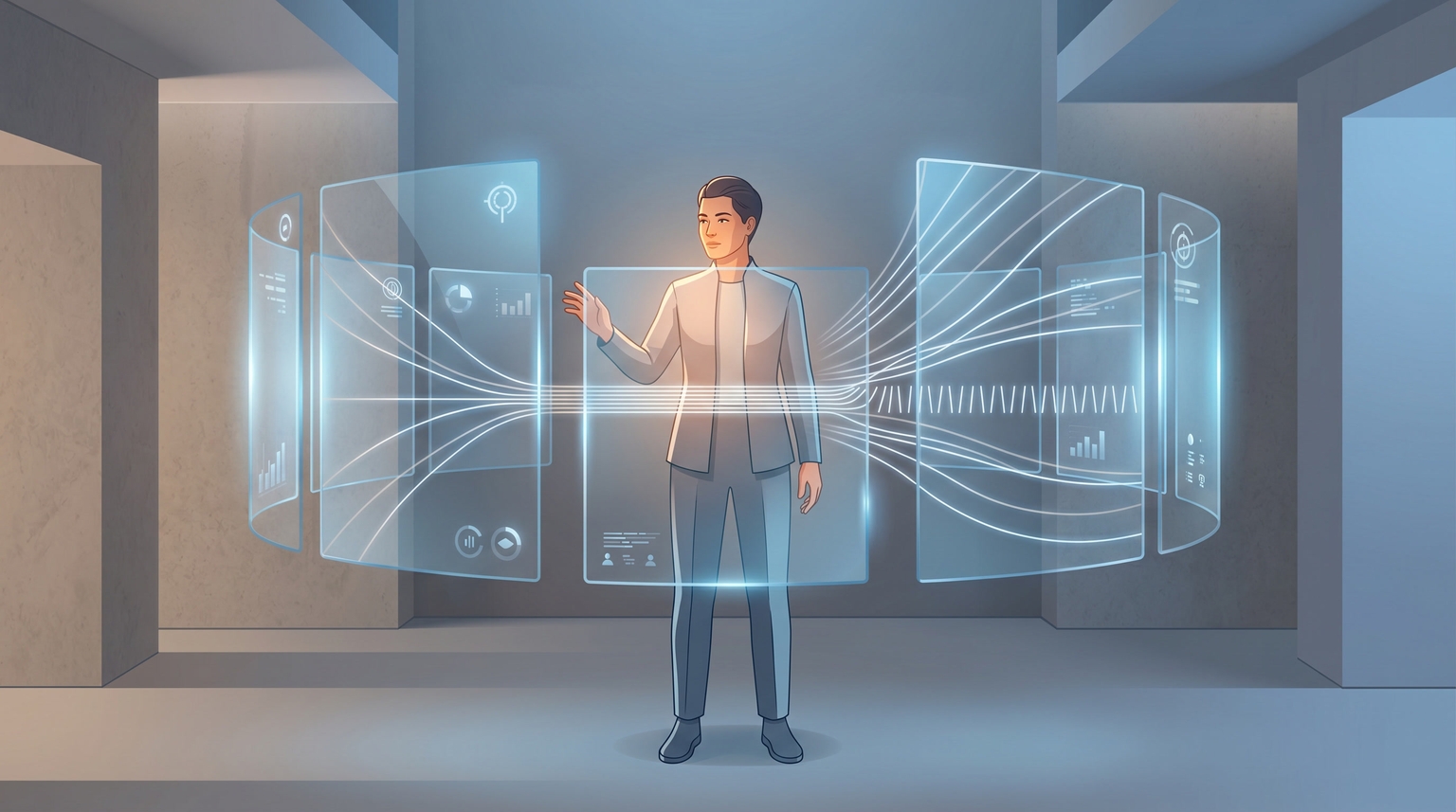 The orchestrator mode puts a human at the center of several parallel AI streams. It's also the mode that most directly conflicts with how the brain actually processes effortful work.
From doing the work to directing it: the four modes#
Microsoft — which has both a research arm studying this and an obvious stake in it — describes four escalating modes of human–AI collaboration:
- Author — you do the work; the AI assists at the margins.
- Editor — the AI drafts; you revise and correct.
- Director — you specify what you want; the AI executes in the background while you do other things.
- Orchestrator — you design a system in which multiple agents run in parallel across a workflow, and they flag exceptions and escalations to you.
That fourth mode is the new frontier of multitasking, and the problem should already feel familiar from Part One. By design, the orchestrator is a human supervising several semi-autonomous processes at once — but the human brain processes effortful tasks in a serial queue. Orchestration asks you to do, all day long, precisely the thing the brain is worst at.
The oversight burden, or: the "irony of automation" returns#
The counterintuitive part: AI does not simply save effort. It relocates it.
Recent work in human–computer interaction — including Tankelevitch and colleagues' CHI 2024 paper on the metacognitive demands of generative AI and Sarkar, Sellen, and Rintel's 2024 research on scalable oversight — describes the pattern: AI reduces your first-order effort — the actual drafting, summarizing, coding, calculating — while increasing your second-order effort: the metacognitive work of deciding when to trust the output, when to verify it, when to intervene, and how to recover when it goes wrong. The work moves up a level, from doing to judging.
And when you're supervising not one AI but several parallel agents, the bottleneck of human work shifts decisively away from execution and toward oversight, interpretation, and recovery capacity. You become the constraint. The agents can generate work faster than you can responsibly check it. And, oh buy, I know the feeling...
This is not a new discovery so much as the return of a very old one. In 1983, the engineering psychologist Lisanne Bainbridge described what she called the "irony of automation." When you automate the routine parts of a job and leave the human to handle only the exceptions, you create a cruel bind: the human gets less and less practice at the underlying task (because the machine usually handles it), yet is expected to swoop in competently exactly when the machine fails — which is the hardest moment, requiring the most skill. Decades of research in aviation and medicine bear this out.
There's a further twist specific to monitoring. Vigilance research — the study of sustained attention to detect rare signals, originally driven by wartime radar operators — has established the "vigilance decrement": human ability to detect important-but-infrequent events reliably declines over time, and the act of vigilant monitoring is itself surprisingly effortful and fatiguing. Watching a fleet of agents for the moments they need you is not restful background activity. It's a draining task in its own right, even when nothing happens.
What the data says about the new workplace#
Microsoft's annual Work Trend Index has become the most-cited barometer of these shifts, and it's worth reporting its findings — with a caveat I'll flag clearly.
The 2025 edition surveyed 31,000 workers across 31 countries and introduced the "Frontier Firm" and "agent boss" concepts. Among its headline numbers: 82 percent of leaders said they considered it a pivotal year to rethink core strategy and operations, and 81 percent said they expected AI agents to be moderately or extensively integrated into their company's AI strategy within the next 12 to 18 months. The 2026 edition surveyed 20,000 knowledge workers across 10 markets (fielded February through April 2026) and layered in usage telemetry from Microsoft's own Copilot. It reported that 49 percent of Copilot chats supported "cognitive work" — analysis, problem-solving, evaluation — and that 86 percent of AI users say they treat AI output as a starting point rather than a final answer.
The caveat: independent analysts have pointed out, fairly, that many of these headline statistics are self-reported survey signals, not hard behavioral measurements — and that as a report partly serving Microsoft's commercial interests, the Work Trend Index tends to under-emphasize the risks, including the "jagged frontier" problem we'll get to. Treat the numbers as a directional read on where work is heading, not as precise scientific findings.
Cognitive offloading and the specter of skill atrophy#
The question everyone actually wants answered: is leaning on AI making us cognitively weaker?
Start with the right concept. Cognitive offloading — using an external tool to reduce mental effort — is ancient and usually benign. Writing a grocery list rather than memorizing it is offloading. So is using a calculator, or saving a phone number instead of remembering it. Offloading becomes a problem — call it cognitive atrophy — only when you offload work that would otherwise build or maintain a skill you need. The grocery list costs you nothing. Letting an AI do all your reasoning might cost you your ability to reason.
Three studies from 2025 have shaped the conversation. Each is worth reading precisely — including its limits.
The MIT Media Lab "Your Brain on ChatGPT" study (Kosmyna and colleagues, posted to arXiv as paper 2506.08872) is the one that went viral. The researchers had 54 participants in the Boston area write essays across several sessions, divided into three groups: one using ChatGPT, one using a traditional search engine, and one using no tools at all ("brain-only"). They recorded EEG across 32 brain regions throughout. The findings were striking. The ChatGPT group consistently showed the weakest brain connectivity of the three — up to 55 percent reduced connectivity compared to the brain-only group — and a remarkable 83 percent of the ChatGPT users were unable to quote anything from the essays they had just written minutes earlier. The team coined the phrase "cognitive debt" to describe the accumulating cost of outsourcing the thinking.
Well, this study has real limits, and its own authors are the first to say so. The sample is small — only 18 participants completed the crucial crossover session. As of its release it had not been peer-reviewed. It tested only ChatGPT and only the narrow task of essay-writing. And the researchers explicitly pleaded with the public not to run with "AI makes you dumb" or "brain damage" framings, because the study shows short-term neural and behavioral patterns under specific conditions, not proof of lasting cognitive decline. There's a hopeful finding buried in it too: a "brain-to-LLM" group that did the cognitive work first and brought in the AI afterward retained stronger memory and engagement. Sequence matters, I guess...
Your Brain on ChatGPT: Accumulation of Cognitive Debt when Using an AI Assistant for Essay Writing Task
This study explores the neural and behavioral consequences of LLM-assisted essay writing. Participants were divided into three groups: LLM, Search Engine, and Brain-only (no tools). Each completed three sessions under the same condition. In a fourth session, LLM users were reassigned to Brain-only group (LLM-to-Brain), and Brain-only users were reassigned to LLM condition (Brain-to-LLM). A total of 54 participants took part in Sessions 1-3, with 18 completing session 4. We used electroencephalography (EEG) to assess cognitive load during essay writing, and analyzed essays using NLP, as well as scoring essays with the help from human teachers and an AI judge. Across groups, NERs, n-gram patterns, and topic ontology showed within-group homogeneity. EEG revealed significant differences in brain connectivity: Brain-only participants exhibited the strongest, most distributed networks; Search Engine users showed moderate engagement; and LLM users displayed the weakest connectivity. Cognitive activity scaled down in relation to external tool use. In session 4, LLM-to-Brain participants showed reduced alpha and beta connectivity, indicating under-engagement. Brain-to-LLM users exhibited higher memory recall and activation of occipito-parietal and prefrontal areas, similar to Search Engine users. Self-reported ownership of essays was the lowest in the LLM group and the highest in the Brain-only group. LLM users also struggled to accurately quote their own work. While LLMs offer immediate convenience, our findings highlight potential cognitive costs. Over four months, LLM users consistently underperformed at neural, linguistic, and behavioral levels. These results raise concerns about the long-term educational implications of LLM reliance and underscore the need for deeper inquiry into AI's role in learning.
arxiv.org/abs/2506.08872The Microsoft and Carnegie Mellon study (Lee and colleagues, presented at CHI 2025) surveyed 319 knowledge workers about 936 real AI-assisted tasks they'd actually done. Its central finding is, I think, the most practically useful sentence in this whole literature: higher confidence in the AI is associated with less critical thinking, while higher confidence in yourself is associated with more. The danger isn't AI per se — it's trusting it too much. The study also found that GenAI shifts the locus of critical thinking: away from producing the work and toward verifying information, integrating responses, and stewarding the task. And, predictably, people applied more critical thinking on high-stakes tasks and less on routine, low-stakes ones — especially under time pressure, exactly when shortcuts are most tempting and least examined.
The Gerlich study (2025, in the journal Societies) surveyed and interviewed 666 participants in the UK, using the well-validated Halpern Critical Thinking Assessment. It found a significant negative correlation between frequent AI use and critical-thinking scores, statistically mediated by cognitive offloading — and the effect was strongest among the youngest users, aged 17 to 25. This too is correlational — it can't prove AI caused the lower scores. But the developmental angle matters. Older users may largely be offloading tasks they already know how to do — a potentially recoverable kind of atrophy, like a muscle that weakens but can be rebuilt. Younger users, who've never known a world without these tools, may be skipping the skill-building phase altogether — a more troubling possibility, where the capacity never develops in the first place.
So does AI reduce cognitive load or increase it? Yes.#
The honest answer: it depends entirely on the task and how the work is designed. Both things can be true at once.
AI clearly reduces load when it handles genuinely routine, well-specified work — boilerplate code, first drafts, summarization, reformatting data — freeing up scarce working memory for higher-order thinking. And the productivity gains can be real and large. Brynjolfsson, Li, and Raymond, in a study of 5,179 customer-support agents published in the Quarterly Journal of Economics in 2025, found that access to an AI assistant increased productivity (measured in issues resolved per hour) by 14 percent on average — with a striking 34 percent improvement for novice and low-skilled workers, and minimal impact on the already-expert ones. Similarly, a 2023 field experiment by Dell'Acqua and colleagues with Boston Consulting Group found that consultants using AI completed 12.2 percent more tasks and produced 40 percent higher-quality work — on tasks that fell within AI's capabilities.
That last clause is the whole ballgame, and it points to where AI increases load — and worse, degrades quality. The same BCG study found that on tasks outside AI's competence, consultants using the tool did 19 percentage points worse than those without it. This is the now-famous "jagged frontier": AI is brilliant at some tasks and confidently, fluently terrible at others, and the boundary between the two is invisible and irregular. Working near that frontier adds cognitive load, because now you have to verify, prompt-engineer, integrate, and supervise — and you have to do the hardest meta-task of all, which is figuring out whether this particular task is one the AI can actually be trusted with. There's a further documented cost sometimes called "mechanized convergence" or "diversity collapse": teams leaning on the same models tend to produce more homogeneous, samey outputs, quietly narrowing the range of ideas in circulation.
What happens to flow and deep work#
There's one more casualty to name. Flow — the deep, absorbed state where you lose track of time and do your best work — and what Cal Newport calls "deep work" both require sustained, uninterrupted concentration. Newport cites estimates that reaching deep focus takes 20 minutes or more. That's a long ramp, and every interruption knocks you back to the bottom.
AI can cut either way here. Used well, it protects flow by clearing away the drudgery that used to break it up. Used badly — as a steady stream of monitoring pings, verification loops, and context-switches between AI tools and your own work — it shatters flow more efficiently than email ever did. And the orchestrator mode sits in direct, unavoidable tension with deep work: supervising multiple agents is, by its very definition, a vigilance-and-switching task. You cannot be in flow and on call for machine escalations at the same time. The bottleneck won't allow it.
Part Three: A Practical Playbook for Knowledge Workers#
Enough diagnosis. Here's what the evidence actually supports doing about it. I've organized it from the most foundational and best-established practices to the newest and most AI-specific, because the foundations matter more and the AI-specific tactics build on them.
 Deliberate, uninterrupted work isn't a luxury. It's the mode your brain needs to do its best thinking — and it takes active protection to maintain in an environment designed to fragment it.
A. Protect your attention (the well-established foundations)#
Single-task and time-block your day. This is the direct answer to the serial bottleneck. Cal Newport's prescription in Deep Work is to schedule distraction-free blocks for your most cognitively demanding work and wall it off from "shallow work" like email and admin. The practice that actually makes this work is time-blocking — assigning each hour of your day to a specific kind of work in advance, which consistently outperforms working from an open-ended to-do list (a to-do list tells you what; it never tells you when, so everything competes for "now").
Match your method to the task: Pomodoro versus deep blocks. The Pomodoro technique — 25 minutes of work, 5-minute break, repeat — is excellent for getting started, beating procrastination, and grinding through routine tasks where the enemy is inertia. But for genuinely deep work like writing, coding, or hard analysis, those frequent breaks can interrupt flow before you've fully reached it. There, longer blocks of 50 to 90 minutes serve you better. Newport himself suggests something like 50 minutes on, 10 off for sustained work, and warns that peak cognitive intensity simply can't be maintained beyond roughly an hour without rest. Use the short cycles to start; use the long blocks to go deep.
Batch your communications — but don't go dark. This one has an unusually clean experimental basis. Kushlev and Dunn (2015) randomly assigned 124 adults to check email only three times a day, and found it significantly lowered stress and raised well-being versus unlimited checking. A separate field experiment with 237 participants found that batching phone notifications into three daily windows made people more attentive, more productive, and happier. But — and this is the important asterisk — the same line of research found that turning notifications off entirely backfired, raising anxiety and fear of missing out. The sweet spot is scheduled, batched checks, not total disconnection. (One honest caveat: Gloria Mark's 2016 work found that email batching reliably improved perceived productivity but did not always lower physiological stress as cleanly as the popular advice claims. Batching helps; it's not magic.)
Cut context-switching and your own self-interruptions. Remember that roughly half of interruptions are self-inflicted. Use Leroy's "ready-to-resume" trick — a 30-second note on where you left off — before any switch you can't avoid. Close the tabs and apps you're not using. Cluster similar tasks so you switch contexts less often, even if you switch tasks within a context frequently.
B. Work with AI in a way that preserves your mind#
Offload the rote, never the reasoning. This is the single most important principle. Hand the AI your boilerplate, your formatting, your first drafts, your initial searches — the grocery-list stuff. Keep the analysis, the judgment, the synthesis, and the final decision firmly human. Those are the cognitive muscles the MIT and Gerlich studies suggest are most at risk, and the only way to keep a muscle is to use it.
Stay actively in the loop — treat output as a draft. Most AI users already do this: 86 percent in Microsoft's survey treat AI output as a starting point. Make it a discipline rather than a habit you drift away from. Read critically, push back, revise. The Microsoft/CMU finding is blunt: trust the AI less and yourself more, because overconfidence in the tool is what switches off your critical thinking.
Build verification habits scaled to the stakes. Verification, the CMU research shows, is now the core critical-thinking activity of AI-assisted work. Make it explicit: any AI output that will inform a real decision gets checked against an independent source, with the rigor scaled to how much that decision matters. This is also your defense against the jagged frontier — heavy, deliberate verification on high-stakes and unfamiliar tasks is the antidote to that 19-point quality collapse on work the AI can't actually do, but will happily pretend it can.
Deliberately fight skill atrophy. Periodically do representative tasks entirely unaided — not because it's efficient, but because it keeps your baseline competence intact and lets you detect atrophy before it becomes a crisis. If you ever find you can no longer evaluate or improve an AI's output in some domain, that's a flashing signal: you've offloaded a skill you actually need, and it's time to put the tools down in that area for a while.
Build in friction, and get the sequence right. Research from Microsoft and CMU on AI "provocations" — prompts or tools that critique the AI's output and surface alternatives — found they help restore the engagement that smooth, frictionless AI tends to lull you out of. And for genuine learning, remember the MIT study's hopeful finding: do the thinking first, then bring in the AI.
C. Manage multiple agents without drowning in oversight#
This is the newest territory, so the guidance leans more on principle than decades of replication.
Design for exception-based escalation, not constant vigilance. Configure your agents to surface only exceptions and genuinely high-stakes decisions, so you are not monitoring continuously. This directly attacks the vigilance decrement — you can't suffer the fatigue of constant watching if the system is built to tap you on the shoulder only when it matters.
Cap your concurrent streams and batch your check-ins. The serial bottleneck doesn't get suspended just because the other workers are silicon. Supervising too many agents at once is just multitasking with AI. Limit how many parallel streams you'll truly attend to at one time, sequence your agent reviews rather than reacting to each in real time, and batch your check-ins the same way you batch email.
Invest your effort up front, in specs and standards. Microsoft's framing of the high-value human skill in this era: it's setting clear intent — defining the desired outcome and the quality bar — and designing how the work gets done. A precise specification at the start dramatically reduces the verification and rework load at the end. Pay the cognitive cost early, where it's cheapest, rather than late, where it compounds.
Encode oversight into shared routines. Where possible, bake your verification and escalation rules into team norms and governance rather than improvising audits from scratch each time. Think of it as building "guardrails for the human," not just for the model — a clear, shared answer to who checks what, when, and how so that accountability is explicit and you're not reinventing the process under pressure.
D. Don't neglect the biological foundations of cognition#
All of this runs on hardware that needs maintenance — and these are, frankly, the most reliably evidenced items on the list.
Sleep. Sleep deprivation reliably degrades exactly the things we've been discussing: vigilance and sustained attention, working memory, and executive control. During sleep, features like sleep spindles and slow-wave sleep do the work of consolidating memory. Consistent, sufficient sleep isn't something you layer on top of focus work — it's what everything else runs on.
Exercise. Aerobic exercise improves executive function and memory and has been shown to increase gray-matter volume in the hippocampus and prefrontal cortex — the very regions that do your effortful thinking. One study even found that exercise training protected sustained attention against the effects of sleep deprivation (though, tellingly, it didn't fully rescue working memory — so exercise complements sleep, it doesn't replace it). Both one-off bouts and regular training help.
Real breaks and recovery. Peak cognitive intensity can't be sustained for long, so the rest intervals in Pomodoro and what Newport calls "deep breaks" aren't indulgences — they're part of the work. The most restorative breaks tend to be physical and a clean break from screens — a walk outside beats scrolling your phone, which is just more of the same fragmentation.
The Playbook in Stages#
If that feels like a lot, here's how to sequence it — with signals for when to adjust.
- Individual habits: Block one or two daily deep-work sessions of 50 to 90 minutes for your hardest work, notifications silenced. Batch email and Slack into about three scheduled windows a day — but don't go fully dark. Write a 30-second "where I left off" note before any task switch. And protect your sleep and add aerobic exercise.
- Working with AI: Decide upfront what you'll hand off (rote work, first drafts) and what stays yours (reasoning, judgment, final calls). Check any AI output that feeds into a real decision, with scrutiny scaled to the stakes. And at least once a week (pick your own cadence, really) — or once per skill you care about — do a representative task with no AI at all.
- Managing agents: Configure agents to escalate by exception, not to demand continuous monitoring. Cap how many run concurrently and batch your reviews; sequence rather than parallelize when the work is cognitively demanding. Write clear specs and quality bars upfront to cut down on oversight later. The signal you've over-parallelized: if oversight and verification cost more time and stress than the work they replaced, or you feel permanently "on call" for machine escalations, cut the concurrency and redesign your escalation rules.
- For leaders and teams: Treat human attention as a limited resource that has to be designed for, not assumed. Set clear norms for notifications, protected focus time, and how often agents get reviewed — guardrails for the humans, not just the AI. Build verification and critical-thinking checkpoints, including the provocation-style prompts mentioned above, into AI workflows rather than optimizing purely for speed. And track burnout signals — exhaustion, cynicism, falling confidence — right alongside productivity, so problems surface while they're still reversible.
The Bottom Line#
Strip away the headlines and the hype, and the picture is clarifying rather than alarming. Your brain has always processed effortful thought one task at a time — multitasking has always meant paying a quiet, invisible cost on every switch: in time, in errors, in the residue of the task you just left.
AI doesn't remove that limit, rather, it changes what you spend your attention on. As AI takes over more execution, your job shifts from doing to overseeing — and oversight, for all that it feels lighter, is demanding cognitive work in its own right, work that multiplies as you supervise more parallel streams. Used well, these tools free your mind for higher-order thinking. Used carelessly, they fragment it more efficiently than anything that came before. Which outcome you get isn't determined by the technology — it's determined by how you design your work around it.
The good news: the same principles address both halves of the problem. Single-task when it counts. Offload the rote, guard the reasoning. Verify in proportion to the stakes. Build in real recovery. Respect the bottleneck instead of fighting it. None of this requires rejecting AI — it requires using it like someone who understands the machine they're actually working with: the one between your ears.
References and Further Reading#
The neuroscience of multitasking and task-switching
- Rubinstein, J. S., Meyer, D. E., & Evans, J. E. (2001). Executive control of cognitive processes in task switching. Journal of Experimental Psychology: Human Perception and Performance, 27(4), 763–797. DOI: 10.1037/0096-1523.27.4.763
- American Psychological Association. Multitasking: Switching costs. (Summary of David Meyer's work, including the "up to 40%" figure.)
- Earl Miller, MIT Picower Institute — commentary on the serial nature of "multitasking." See millerlab.mit.edu.
- Ultrafast fMRI reveals serial queuing of information processing during multitasking in the human brain. Nature Communications (2025).
Attention residue and interruptions
- Leroy, S. (2009). Why is it so hard to do my work? The challenge of attention residue when switching between work tasks. Organizational Behavior and Human Decision Processes, 109(2), 168–181. DOI: 10.1016/j.obhdp.2009.04.002
- Zeigarnik, B. (1927). On finished and unfinished tasks. (The Zeigarnik effect.)
- Mark, G., Gudith, D., & Klocke, U. (2008). The cost of interrupted work: More speed and stress. Proceedings of CHI 2008.
- Mark, G. (2023). Attention Span — research on the decline of on-screen attention duration (2.5 min → ~47 sec) and the ~23-minute resumption figure.
Does multitasking harm the brain? (and the rebuttals)
- Ophir, E., Nass, C., & Wagner, A. D. (2009). Cognitive control in media multitaskers. PNAS, 106(37), 15583–15587.
- Stanford Report (2009). Media multitaskers pay mental price, Stanford study shows.
- Loh, K. K., & Kanai, R. (2014). Higher media multi-tasking activity is associated with smaller gray-matter density in the anterior cingulate cortex. PLoS ONE, 9(9). DOI: 10.1371/journal.pone.0106698
- Wiradhany, W., & Nieuwenstein, M. R. (2017). Cognitive control in media multitaskers: Two replication studies and a meta-analysis. Attention, Perception, & Psychophysics, 79, 2620–2641.
- Parry, D. A., & le Roux, D. B. (2021). "Cognitive Control in Media Multitaskers" Ten Years On: A Meta-Analysis. Cyberpsychology.
- Uncapher, M. R., & Wagner, A. D. (2018). Minds and brains of media multitaskers. PNAS, 115(40), 9889–9896. DOI: 10.1073/pnas.1611612115
- The Chronicle of Higher Education (2013). Obituary and overview of Clifford Nass's multitasking research.
Supertaskers
- Watson, J. M., & Strayer, D. L. (2010). Supertaskers: Profiles in extraordinary multitasking ability. Psychonomic Bulletin & Review, 17(4), 479–485.
- Sanbonmatsu, D. M., Strayer, D. L., et al. (2013). Who multi-tasks and why? Multi-tasking ability, perceived multi-tasking ability, impulsivity, and sensation seeking. PLoS ONE. DOI: 10.1371/journal.pone.0054402
AI, cognition, and the workplace
- Microsoft. Work Trend Index (2025 and 2026 editions).
- Tankelevitch, L., et al. (2024). The metacognitive demands and opportunities of generative AI. Proceedings of CHI 2024.
- Sarkar, A., Sellen, A., & Rintel, S. (2024). Research on AI, metacognition, and oversight burden in knowledge work (Microsoft Research).
- Bainbridge, L. (1983). Ironies of automation. Automatica, 19(6), 775–779. DOI: 10.1016/0005-1098(83)90046-8
- Kosmyna, N., et al. (2025). Your Brain on ChatGPT: Accumulation of Cognitive Debt when Using an AI Assistant for Essay Writing. arXiv:2506.08872.
- Lee, H.-P., et al. (2025). The impact of generative AI on critical thinking: Self-reported reductions in cognitive effort and confidence effects from a survey of knowledge workers. Proceedings of CHI 2025.
- Gerlich, M. (2025). AI tools in society: Impacts on cognitive offloading and the future of critical thinking. Societies, 15(1).
- Brynjolfsson, E., Li, D., & Raymond, L. R. (2025). Generative AI at work. Quarterly Journal of Economics.
- Dell'Acqua, F., et al. (2023). Navigating the jagged technological frontier: Field experimental evidence of the effects of AI on knowledge worker productivity and quality. Harvard Business School Working Paper / Organization Science, 2025.
Practical strategies and foundations
- Newport, C. (2016). Deep Work: Rules for Focused Success in a Distracted World.
- Kushlev, K., & Dunn, E. W. (2015). Checking email less frequently reduces stress. Computers in Human Behavior, 43, 220–228. DOI: 10.1016/j.chb.2014.11.005
- Fitz, N., et al. (2019). Batching smartphone notifications can improve well-being. Computers in Human Behavior, 101, 84–94. DOI: 10.1016/j.chb.2019.07.016
- Mark, G., et al. (2016). Email duration, batching and self-interruption: Patterns of email use on productivity and stress. Proceedings of CHI 2016.
- Sweller, J. — Cognitive Load Theory (foundational; see Sweller 1988, Cognitive Science, 12, 257–285).
- World Health Organization (2019). Burn-out as an "occupational phenomenon" (ICD-11).
- Research on aerobic exercise, hippocampal/prefrontal gray matter, sleep deprivation, and sustained attention. Anchor: Erickson, K. I., et al. (2011). PNAS, 108(7), 3017–3022. DOI: 10.1073/pnas.1015950108
Originally published at https://iuriio.com/blog/posts/2026/06/brain-multitask-ai